
Professional Tax Registration for Freelancers & Self-Employed: Complete Guide (India)

TaxVic
Tax Consultant
Adding Foreign Directors and Shareholders to an Indian Company

TaxVic
Finance Consultant
How to File ITR if You Have Both Salary and Freelance Income

TaxVic
Finance Consultant
Taxes & Compliances you must know about if you provide services outside India

TaxVic
Tax Consultant
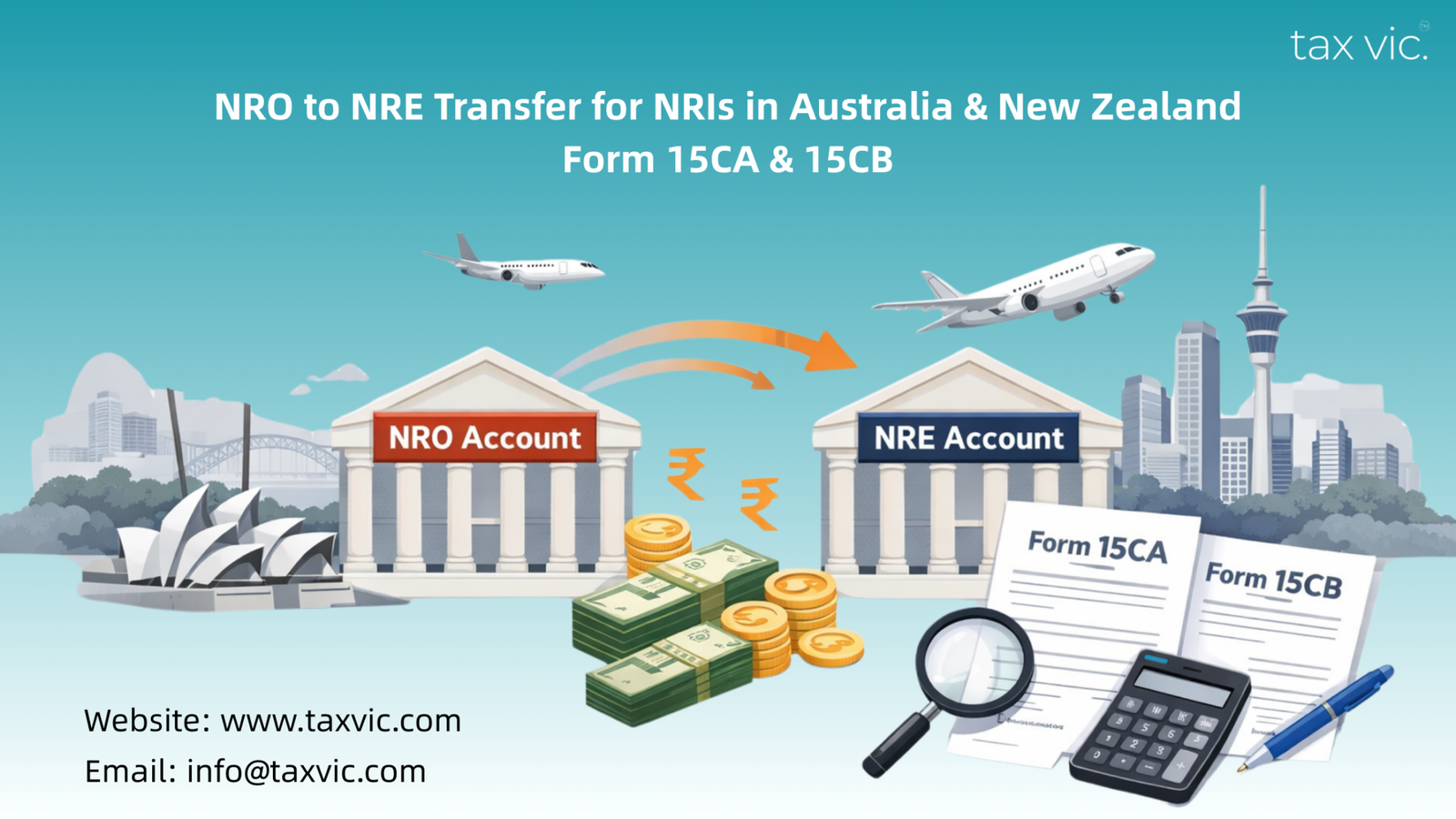
NRO to NRE Transfer for NRIs in Australia & New Zealand
TaxVic
Tax Consultant
 Content Creator Tax & Compliance Guide in India - GST, Income Tax and Tax Planning Explained A practical guide for YouTubers, Instagram influencers, UGC creators, podcasters, streamers and digital content creators. Published by TaxVic | Tax, Accounting & Compliance for Creators and Freelancers Are you earning as a creator but ignoring your compliances? You started creating content two or three years ago. You have built an audience, begun receiving brand collaborations, earned money from YouTube or Instagram, or started working with international brands. But have you stopped to ask yourself: Do I need GST registration? If my income is below ₹20 lakh, do I still have to file an income-tax return? If I receive money from a US company, is it automatically an export of services? Can I legally reduce my tax through presumptive taxation? What happens if I receive free products from a brand instead of money? Many creators focus on growing their audience and monetising their content but overlook the financial and legal obligations that come with earning money. Some avoid GST registration because they think it will increase their taxes. Others assume that if no tax is payable, there is no need to file an income-tax return. GST compliance, income-tax compliance and tax planning are three separate matters. Each must be evaluated independently. 1. Understand how you earn money as a creator A content creator may earn income from several sources. The tax treatment can depend on the actual nature of each earning, the contract, the recipient and the payment arrangement. Income source Example Brand collaborations A skincare brand pays you to promote its product on Instagram. Sponsored content A company pays you to publish a sponsored YouTube video. Platform monetisation You earn advertising revenue through YouTube or another platform. UGC creation You create videos for a brand to use in its own advertising. Affiliate marketing You receive a commission when someone purchases through your link. Paid subscriptions Followers pay for exclusive content or memberships. Digital products You sell templates, courses, guides or e-books. Consulting and workshops You charge for creator coaching, speaking or training. Gifts and barter collaborations A brand gives you products or a stay in exchange for promotional content. These income streams should not automatically be treated identically. A paid brand campaign may be a service, affiliate earnings may involve a commission arrangement, and selling a digital product may have a different GST classification from providing a service. Your compliance depends on what you actually do, not merely on whether you call yourself an influencer. 2. GST and income tax are two different laws GST: Is registration required, and do you need to charge GST? GST generally concerns the supply of goods and services. Registration liability depends on factors such as aggregate turnover, the nature of your supplies, your location and applicable exemptions. Once registered, you may need to issue invoices, charge GST where applicable, file returns and maintain records. Income tax: How much of your earnings is taxable? Income tax concerns the income you earn during the relevant tax year. Taxable income is determined under the applicable income-tax provisions, taking into account eligible expenses, presumptive taxation where available, other income and applicable deductions or exemptions. One creator, two different compliance tests Suppose you earn ₹15 lakh from brand collaborations and YouTube monetisation in a year. GST: You may be below the usual ₹20 lakh registration threshold, subject to the applicable rules and the nature of your supplies. Income tax: You must separately determine your taxable income and whether an income-tax return is mandatory. If your earnings increase to ₹30 lakh, you will generally cross the usual registration threshold for taxable services in states where ₹20 lakh applies, subject to the law. Your income tax must still be calculated separately. The ₹20 lakh figure is not a universal income-tax exemption. It is commonly relevant to GST registration for service providers in most states. 3. GST for creators providing services in India Scenario A: Your creator income is below ₹20 lakh Suppose you are an Instagram creator based in Noida and earn ₹6 lakh from brand collaborations, ₹4 lakh from YouTube monetisation and ₹3 lakh from UGC creation. Your relevant receipts total ₹13 lakh. If you supply taxable services from a state where the usual registration threshold is ₹20 lakh, and no special mandatory-registration rule applies, you will generally not be required to register solely because you provide services to brands or platforms. Do not look at only one income source. GST aggregate turnover is generally calculated on an all-India PAN basis and includes relevant taxable, exempt and export supplies as prescribed by law. The threshold is ₹10 lakh in certain special-category states, subject to applicable statutory provisions and notifications. Practical takeaway: If you are below the applicable threshold and no exception applies, you may be able to operate without GST registration. Maintain records and assess income-tax obligations independently. Scenario B: Your creator income exceeds ₹20 lakh Suppose you earn ₹28 lakh from Indian brand collaborations, video production, sponsored posts and other taxable services. If you are based in a state where the usual ₹20 lakh threshold applies and your aggregate turnover exceeds it, you will generally need GST registration unless a specific exemption or other provision changes the result. After registration, evaluate: Whether GST is chargeable on each service and the applicable rate/classification. Whether the contract states that fees are inclusive or exclusive of GST. Whether tax invoices must be issued and which returns must be filed. Whether eligible input tax credit can be claimed. For example, if a contract provides for a professional fee of ₹1,00,000 plus GST, the brand may pay the fee and GST separately. If ₹1,00,000 is inclusive of GST, tax may need to be calculated out of that amount, depending on the agreed terms. Do not wait until the end of the financial year to examine turnover. Monitor it throughout the year and assess registration deadlines under the applicable rules. Scenario C: You work with brands in other Indian states A creator in Delhi may collaborate with
 Do Freelancers Need to File EDF? RBI’s 7 October Clarification Explained - Quick answer: If you work for foreign clients in your own name, RBI said on 7 October 2026 that you do not need to file the Export Declaration Form (EDF). If you bill through a company, LLP or partnership firm, you do, every month, within 30 days from the end of the month of the invoice. RBI has promised FAQs to confirm the exact line; they are not out yet. From 1 October 2026, RBI asked every Indian business that sells services abroad to file a monthly form with its bank. For a week, freelancers, tutors and creators thought they were in it too. Then the RBI stepped in. Here is what was said, what the written rule still says, and what you should do today. What is the EDF, in one line? The EDF is a form you give your bank saying “I billed this foreign client this much this month”. Your bank then tracks it until the money arrives in India. It is a foreign exchange report, not a tax return. What exactly did RBI say on 7 October 2026? At the press conference after its policy meeting, RBI’s top officials addressed the confusion directly: Governor Sanjay Malhotra said individuals who provide services abroad and get paid for it (he gave tutoring and small software work as examples) are not required to report as per the invoice, it would be simpler for them. Deputy Governor Rohit Jain said individuals are not covered for contracts of a personal nature, and that RBI will clarify through FAQs shortly. The Governor also said that for businesses that do file, a self-declaration is enough for bills up to ₹10 lakh each. This is a simpler way to report, not an exemption. So why are some CAs still saying “file it”? Because the written rule has not changed yet. Regulation 3(2) of the FEMA (Export and Import of Goods and Services) Regulations, 2026 says “an exporter of services” must file. It has no carve-out for individuals and no minimum amount. A statement at a press conference is a strong signal of how RBI and banks will act. But until RBI publishes the FAQs or amends the rule, two questions stay open: What is a “contract of a personal nature”? Is a sole proprietor with GST registration and staff an “individual” or a business? Do I need to file? Find your situation Your situation What to do now Private limited company, LLP or partnership firm billing foreign clients File the EDF every month. The 7 Oct statement does not cover you. Agency or studio run as a sole proprietorship (GST, trade name, employees) Grey area. You look like a business. Safest: file, and ask your bank in writing. Freelancer billing in your own name (designer, developer, writer, tutor, consultant) RBI says you need not report. Confirm with your bank and keep your records. Software business that used to file SOFTEX File the EDF instead. SOFTEX is gone from 1 Oct 2026. YouTube, AdSense or other platform payouts Not addressed by RBI yet. Ask your bank how it wants these handled. Paid through Upwork, Payoneer or similar Same answer as your row above. The platform does not file for you. What every freelancer should still do Even if you are outside the EDF, your foreign income is watched through other routes. Keep these clean: 1.Raise a proper invoice for every foreign client, with date, amount, currency and service description. 2.Collect your FIRA or FIRC (the bank’s proof that foreign money came in) for each payment. 3.Check the purpose code on every inward payment. It should describe your service, not “gift” or “family support”. 4.Declare the income in your ITR. The EDF never replaced income tax. If you use presumptive tax, see our post on Section 58 (old 44ADA). 5.If you are GST-registered, keep your LUT current so exports stay at 0% GST. What if my bank still asks me for an EDF? It is Banks responsibility to guide you for the EDF, in fact they will ask you by guiding you where you are required to file whether on the basis of invoice or on receipt basis. Does the EDF change my income tax or GST? No. The EDF is reporting under FEMA, the foreign exchange law. Your income tax, advance tax and GST stay exactly as before. Key takeaways Companies, LLPs and firms exporting services: file the EDF monthly from October 2026 invoices. Individuals working in their own name: RBI says no reporting needed on invoice basis for below 10 lacs transaction; confirm with your bank. Sole proprietors running agency-style businesses: grey area until RBI’s FAQs. Keep invoices, FIRAs and correct purpose codes whatever your status. Frequently asked questions Is the EDF mandatory for freelancers in India? Not for individuals working in their own name, according to RBI’s statement of 7 October 2026. The written regulation does not yet say so, and RBI’s FAQs are awaited. Check with your bank. I am a freelancer earning more than ₹10 lakh a year. Does that change anything? No. RBI’s comment on individuals did not depend on the amount. The ₹10 lakh figure is a separate relief for businesses that do file: it applies per invoice, not per year. Do I need an IEC (Importer Exporter Code) as a freelancer? The EDF rule does not make you get one. If you are filing an EDF as a business, in fact IEC is a separate topic, as a GST registered freelancer you must have IEC. I have a one-person company. Am I an individual? No. A private limited company, OPC or LLP is a separate legal person. It must file. What happens if I should have filed and didn’t? Missing a FEMA filing can attract a penalty under Section 13 of FEMA. Banks can also hold your inward payments for clarification. If you are unsure, file or get advice before your first due date, 30 November 2026. When will RBI release the EDF FAQs? RBI said “shortly”
 EDF Form for Service Exporters from 1 October 2026: A CA’s Guide - What is the EDF form for service exporters? The Export Declaration Form (EDF) is an RBI declaration in which a service or software exporter reports the full value of exports made in a month. From 1 October 2026, it must be filed with the Authorised Dealer (AD) bank within 30 days from the end of the month in which the invoice is raised. From 1 October 2026, Indian service exporters get a new monthly task: filing an Export Declaration Form (EDF) with their bank. Until now, goods exporters filed an EDF, software exporters filed SOFTEX, and most other service exporters filed no declaration at all. The new RBI export-import regulations change that, because RBI wants clearer visibility of service exports. What has changed RBI notified the FEMA (Export and Import of Goods and Services) Regulations, 2026 as FEMA 23(R)/2026-RB on 13 January 2026. They take effect on 1 October 2026 and were amended on 22 September 2026. In plain terms: Requirement Position from 1 October 2026 Who files All service and software exporters, including freelancers, agencies and SaaS companies Where Your AD bank (STPI or the Development Commissioner in certain software and SEZ cases) When Within 30 days from the end of the month in which the invoice is raised How often One EDF a month, covering all your overseas clients Software exports EDF replaces SOFTEX Realisation of payment 9 months from invoice date (12 months for specified INR exports) Small invoices For invoices up to ₹10 lakh, you can close the bank’s tracking entry (EDPMS) by declaring that payment has been received. Quarterly bulk declarations are allowed. Note: several early guides still quote a 15-month realisation period. The September amendment reduced it to 9 months, so use the shorter period when setting reminders. Who files, and for which invoices? Every service and software exporter, including freelancers, consultants and agencies. Invoices dated on or after 1 October 2026. Current guidance says earlier invoices fall outside the EDF, even if payment arrives later. One EDF per month can cover several overseas clients. For services other than software, such as consulting or design, the EDF may also be submitted on or before the date payment is received. A worked example A Noida design agency invoices clients in the US and UK on 6 October and 20 October 2026. It files a single EDF covering both invoices by 30 November 2026. Payment for the 20 October invoice must then be realised by 20 July 2027, or the agency must ask its bank for an extension and give reasons. Practical checklist before your first filing Ask your AD bank for its EDF process and operating procedure. Set 1 October 2026 as the cut-off date in your invoicing records. Keep a monthly export register with invoice number, client, currency and value. Diarise the EDF due date early each month. Reconcile invoices, EDF, bank receipts and EDPMS every month, and keep your FIRC or eFIRA as proof of receipt. If you use SOFTEX today, confirm with your bank or STPI how to switch. Compliance and common mistakes Assuming freelancers are exempt. They are not. Applying the old 15-month period to realisation of payment. Letting invoice value, EDF and bank receipt differ. Mismatches can trigger bank queries and may delay eBRC or GST refund paperwork. Waiting until the due date to ask your bank how it accepts the form. FAQs Do freelancers need to file an EDF? Yes. Every service and software exporter must file, including freelancers. Can I file one EDF for several clients? Yes. One EDF can cover all service exports made in a month, across clients. Is there a separate form for software exports? No. From 1 October 2026 the EDF replaces SOFTEX for software exports. What is the due date for October 2026 invoices? 30 November 2026. Key takeaways The form is the Export Declaration Form (EDF), filed through your bank. It applies to all service and software exports invoiced from 1 October 2026. File monthly, within 30 days from the end of the invoice month. Realisation period is 9 months from invoice date. Reconcile invoices, EDF, receipts and EDPMS every month. Unsure how the EDF applies to your invoices? Speak to a Chartered Accountant before your first filing date. The Tax Vic team can be reached at info@taxvic.com. Source: RBI notification FEMA 23(R)/2026-RB, as amended on 22 September 2026. Please confirm procedural details with your AD bank.
 Supreme Court Tiger Global Ruling: GAAR Overrides TRC & Treaty Protection - There is a lot of talk going around with tiger global ruling. India’s Supreme Court has delivered a landmark tax judgment that will significantly impact foreign investors, venture capital funds, and offshore holding structures. In its ruling dated 15 January 2026, the Supreme Court of India held Tiger Global Management liable to pay capital gains tax in India on its USD 1.6 billion Flipkart exit (2018)-despite routing the transaction through Mauritius entities and holding valid Tax Residency Certificates (TRCs). The verdict sends a clear message:Substance will override form. GAAR can override treaty benefits and TRCs. Background of the Case: What Tiger Global Did Tiger Global exited its investment in Flipkart by selling shares through Mauritius-based holding companies, claiming: Capital gains exemption under India-Mauritius DTAA Protection due to grandfathering provisions Valid Tax Residency Certificates (TRCs) from Mauritius However, Indian tax authorities alleged that: The Mauritius entities were conduit companies They lacked commercial substance The primary purpose of the structure was tax avoidance Accordingly, authorities invoked GAAR (General Anti-Avoidance Rule). What Is GAAR? (Quick Refresher) GAAR is contained in Chapter X-A of the Income-tax Act, 1961 and empowers tax authorities to deny tax benefits if an arrangement is: Primarily designed to obtain tax benefits Lacking commercial substance Misusing or abusing tax treaty provisions Not at arm’s length Importantly, GAAR applies even if the transaction is technically legal. Journey of the Case: From AAR to Supreme Court Authority for Advance Rulings (AAR) Denied treaty benefits; upheld GAAR invocation Delhi High Court Ruled in favour of Tiger Global, accepting TRC and treaty protection Supreme Court of India Overturned Delhi HC decision Held GAAR supersedes TRC and treaty protection This final ruling has now settled the law. The Grandfathering Argument — And Why It Failed What Tiger Global Argued Tiger relied on grandfathering provisions, claiming that: Investments made before 1 April 2017 are protected Article 13(4A) of India–Mauritius DTAA exempts such gains Rule 10U restricts GAAR for grandfathered investments What the Supreme Court Held The Supreme Court clarified that: Grandfathering applies only to direct shares of Indian companies (Article 13(3A)) Indirect transfers fall under the residual clause Tiger’s structure involved indirect transfers, hence no grandfathering Rule 10U(2) allows GAAR to apply to post-April 1, 2017 tax benefits, even if the investment was made earlier Grandfathering is not a blanket shield. Key Takeaway: TRC Is Not Conclusive Proof The Court clearly held that: A Tax Residency Certificate is not conclusive It is only one piece of evidence Authorities are entitled to examine: Commercial substance Decision-making authority Economic risk and control This aligns India with global BEPS principles. What Experts Are Saying Leading tax firms have called this ruling a “game-changer” GAAR can apply even to pre-2017 structures Layered offshore holding companies will face higher scrutiny Mere paper presence in treaty jurisdictions is no longer sufficient Experts also reiterated GAAR’s four tests: Lack of commercial substance Abnormal rights/obligations Misuse of tax law Non–arm’s length arrangement Failing any one test can trigger GAAR. Broader Implications for Investors & Funds For VCs, PE Funds & FPIs Mauritius route loses attractiveness Exit taxes could rise sharply Legacy exits may face reassessment risk Tiger Global’s exposure reportedly exceeds USD 1.5 billion For India Strengthens tax sovereignty Aligns India with OECD BEPS framework Reinforces post-2016 anti-avoidance reforms What Investors Should Do Now If you are a foreign investor or fund: Re-evaluate holding structures Ensure real substance (people, decisions, risks) Document commercial rationale clearly Consider Advance Rulings before exits Explore direct India holding or stronger jurisdictions like Singapore (with substance) What Indian Startups Should Watch Out For If your investors are offshore funds: Expect higher exit tax planning Valuations may factor in tax leakage Deal structures may become more conservative Compliance and documentation will gain importance Final Thoughts The Tiger Global Supreme Court ruling marks a decisive shift in India’s tax jurisprudence. Treaty shopping without substance is officially high risk. GAAR is no longer theoretical- it is enforceable. Tax vic supports foreign businesses entering India, with focused expertise in North India business setup and operations, covering structuring, compliance, and ongoing operational support. Please enable JavaScript in your browser to complete this form.Please enable JavaScript in your browser to complete this form. Name * FirstLast Email *Contact Number *Message Submit
- Transfer Pricing Compliance for Foreign Subsidiary in India: Complete Guide for 2025 - Introduction As India becomes a key market for global businesses, many multinational enterprises (MNEs) set up foreign subsidiaries in the country. However, when these subsidiaries engage in transactions with their parent company or other related entities abroad, Transfer Pricing (TP) regulations under Indian Income Tax Law come into play. Failure to comply with TP rules can lead to audits, penalties, and serious reputational damage. In this blog, we explain Transfer Pricing compliance requirements for foreign subsidiaries operating in India, key deadlines, documentation needs, and how to stay audit-ready. What is Transfer Pricing? Transfer Pricing refers to the pricing of goods, services, and intangibles between related parties (also called associated enterprises or AEs) across international borders. The Indian subsidiary and its foreign parent are considered associated enterprises, and any intercompany transaction between them must be conducted at Arm’s Length Price (ALP) — i.e., the price that would be charged if the parties were unrelated. Who is Covered Under Transfer Pricing Regulations in India? A foreign subsidiary in India is required to comply with TP regulations if it has international transactions with: Its foreign parent company Other group companies or sister concerns abroad Types of Transactions That Attract TP Rules Nature of Transaction Examples Sale/Purchase of Goods Raw materials, finished goods Services Rendered IT, R&D, support services Royalty or License Fee Use of trademarks, patents Loans or Guarantees Intercompany funding Cost Sharing Shared management, admin costs Even a single rupee of international transaction can trigger TP compliance. Transfer Pricing Compliance Checklist for Foreign Subsidiary ✅ 1. Maintain TP Documentation (Rule 10D) You must prepare three-tier documentation: Local File (Indian entity-specific) Master File (group-level info, if applicable) CBCR (Country-by-Country Report, only if global revenue > ₹6400 crore) ✅ 2. Benchmarking Study Justify that your intercompany transactions are at ALP using methods like: Comparable Uncontrolled Price (CUP) Transactional Net Margin Method (TNMM) Cost Plus / Resale Price Method, etc. ✅ 3. Form 3CEB Filing Mandatory for all entities with international transactions Certified by a Chartered Accountant Filed on or before 31st October following the end of financial year ✅ 4. Form 3CD Disclosure Annexure to Tax Audit Report Requires disclosures of TP transactions Penalties for Non-Compliance Default Penalty Not maintaining documentation 2% of transaction value Not filing Form 3CEB ₹1,00,000 Incorrect ALP reporting Up to 100%–200% of tax underreported Not furnishing CBCR (if applicable) ₹5,00,000 and more Case Study: SaaS Subsidiary in India A US-based tech company opens an Indian subsidiary to provide software development support. The Indian entity charges a fixed monthly service fee to the parent. 👉 They must benchmark the fee using TNMM and file Form 3CEB with proper documentation to prove it’s at arm’s length. Missing this can trigger TP audit. Common Mistakes by Foreign Subsidiaries ❌ Treating related party pricing casually ❌ Using generic third-party agreements as proof ❌ Delayed or missed Form 3CEB filings ❌ Ignoring master file or CBCR thresholds ❌ Inadequate documentation in case of scrutiny How TaxVic Can Help You Stay Compliant At TaxVic, we help foreign subsidiaries in India by offering: Benchmarking study and intercompany agreement drafting Form 3CEB filing and documentation under Rule 10D Support during TP audit or notice Strategic planning to reduce TP risk and optimize tax Conclusion Transfer Pricing compliance is not just a tax formality — it’s a critical component of risk management for foreign subsidiaries in India. With increasing digitization and AI-driven scrutiny by tax authorities, ensuring accurate reporting and strong documentation is a must. ✅ File smart. Stay compliant. Avoid penalties. FAQs Is TP compliance required if my foreign subsidiary only provides back-office services? ➡️ Yes, if it receives payments from the foreign parent or any AE, compliance is mandatory. What if I miss the 3CEB deadline? ➡️ A penalty of ₹1,00,000 may apply, and increased scrutiny is likely. Is TP applicable on loans or capital infusion? ➡️ Yes, especially on interest rate charged or waived. 4. Can I do TP study later if I’m not audited? ➡️ No. TP documentation must be maintained proactively before due date. Please enable JavaScript in your browser to complete this form.Please enable JavaScript in your browser to complete this form. Name * FirstLast Email *Contact Number *Message Submit
 Adding Foreign Directors and Shareholders to an Indian Company: A Complete Guide - Foreign investment in Indian companies continues to grow as India strengthens its position in the global economy. Understanding the regulatory framework is essential for businesses looking to add international expertise and capital through foreign directors and shareholders. This guide outlines the process, requirements, and considerations. Legal Framework for Foreign Participation Foreign Directors The Companies Act, 2013 permits foreign nationals to serve as directors of Indian companies, with certain conditions: Residency Requirement: Every company must have at least one director who has stayed in India for at least 182 days in the previous calendar year. Director Identification Number (DIN): All directors, including foreign nationals, must obtain a DIN. Maximum Board Composition: The maximum number of foreign directors on a company’s board is not restricted. Foreign Shareholders Foreign investment in Indian companies is primarily governed by: Foreign Exchange Management Act (FEMA) Foreign Direct Investment (FDI) Policy Reserve Bank of India (RBI) regulations Step-by-Step Process for Adding Foreign Directors 1. Obtaining a Director Identification Number (DIN) For foreign nationals, the DIN application requires: Form DIR-3 submission Passport copy (notarized) Proof of address in the home country Recent photograph PAN card or passport as ID proof In case PAN is not available, declaration in Form 60 Identification and address proof of foreign directors must be apostilled 2. Digital Signature Certificate (DSC) Foreign directors need a DSC for signing documents: Class 2 or Class 3 DSC from authorized certifying agencies Foreign directors must have their documents attested by: The Indian Embassy in their country, or Apostille by the home country under the Hague Convention 3. Board Resolution & Appointment Pass a board resolution approving the appointment File Form DIR-12 with the Registrar of Companies (ROC) Update the company records 4. Compliance Requirements Foreign directors must comply with: Provisions of the Companies Act, 2013 SEBI regulations (for listed companies) Income Tax Act (for remuneration and taxation) Process for Adding Foreign Shareholders 1. Determining the Investment Route Identify the appropriate investment route: Automatic Route: No prior government approval required for sectors with 100% FDI permission Government Route: Prior approval from relevant ministries is needed for restricted sectors 2. KYC Documentation Foreign shareholders must provide: Passport copies (notarized) Proof of address Tax identification documents from their home country Bank account details 3. Structuring the Investment Determine whether the investment will be through equity shares, preference shares, or debentures Ensure compliance with pricing guidelines prescribed by the RBI 4. Filing Requirements File the FC-GPR form with the Authorized Dealer Bank within 30 days of issuing shares Update the Register of Members Report to the RBI through Annual Return on Foreign Liabilities and Assets 5. Post-Investment Compliance Issue share certificates Reporting foreign investment in annual filings Ensure compliance with ongoing FEMA regulations Key Considerations and Challenges 1. Sectoral Caps and Conditions Different sectors have varying FDI limits: 100% in manufacturing, IT services 74% in private banking 49% in insurance Restricted percentages in media, retail, and defense 2. Tax Implications Understand Double Taxation Avoidance Agreements (DTAs) Plan for withholding tax on dividends Address Permanent Establishment concerns 3. Exchange Control Regulations Repatriation of profits Capital account transactions Reporting requirements 4. Due Diligence Conduct thorough background checks on potential foreign directors and shareholders to ensure compliance with: Prevention of Money Laundering Act FEMA regulations Companies Act provisions Best Practices for Successful Integration Clear Documentation: Maintain comprehensive shareholder agreements and director appointment terms Cultural Integration: Create orientation programs for foreign directors about Indian business practices Compliance Calendar: Develop a compliance date for timely filings Professional Assistance: Engage legal and accounting experts specializing in cross-border investments Common Pitfalls to Avoid Overlooking the resident director requirement Neglecting ongoing compliance after the initial appointment Improper valuation of shares Failing to adhere to sectoral caps Missing reporting deadlines Adding foreign directors and shareholders can bring valuable expertise, capital, and a global perspective to Indian companies. However, careful navigation of regulatory requirements is essential to ensure compliance and maximize the benefits of international participation in your company’s governance and ownership structure. If you need personalized guidance through this process, CA Reetu, business head at TAXVIC, can help. CA Reetu, a professional advisor with experience in cross-border business structures, can help ensure a smooth integration of foreign participants into a company. Want an instant response? Write to us at info@taxvic.com Please enable JavaScript in your browser to complete this form.Please enable JavaScript in your browser to complete this form. Name * FirstLast Email *Contact Number *Message Submit
- Content Creator Tax & Compliance Guide in India - GST, Income Tax and Tax Planning Explained A practical guide for YouTubers, Instagram influencers, UGC creators, podcasters, streamers and digital content creators. Published by TaxVic | Tax, Accounting & Compliance for Creators and Freelancers Are you earning as a creator but ignoring your compliances? You started creating content two or three years ago. You have built an audience, begun receiving brand collaborations, earned money from YouTube or Instagram, or started working with international brands. But have you stopped to ask yourself: Do I need GST registration? If my income is below ₹20 lakh, do I still have to file an income-tax return? If I receive money from a US company, is it automatically an export of services? Can I legally reduce my tax through presumptive taxation? What happens if I receive free products from a brand instead of money? Many creators focus on growing their audience and monetising their content but overlook the financial and legal obligations that come with earning money. Some avoid GST registration because they think it will increase their taxes. Others assume that if no tax is payable, there is no need to file an income-tax return. GST compliance, income-tax compliance and tax planning are three separate matters. Each must be evaluated independently. 1. Understand how you earn money as a creator A content creator may earn income from several sources. The tax treatment can depend on the actual nature of each earning, the contract, the recipient and the payment arrangement. Income source Example Brand collaborations A skincare brand pays you to promote its product on Instagram. Sponsored content A company pays you to publish a sponsored YouTube video. Platform monetisation You earn advertising revenue through YouTube or another platform. UGC creation You create videos for a brand to use in its own advertising. Affiliate marketing You receive a commission when someone purchases through your link. Paid subscriptions Followers pay for exclusive content or memberships. Digital products You sell templates, courses, guides or e-books. Consulting and workshops You charge for creator coaching, speaking or training. Gifts and barter collaborations A brand gives you products or a stay in exchange for promotional content. These income streams should not automatically be treated identically. A paid brand campaign may be a service, affiliate earnings may involve a commission arrangement, and selling a digital product may have a different GST classification from providing a service. Your compliance depends on what you actually do, not merely on whether you call yourself an influencer. 2. GST and income tax are two different laws GST: Is registration required, and do you need to charge GST? GST generally concerns the supply of goods and services. Registration liability depends on factors such as aggregate turnover, the nature of your supplies, your location and applicable exemptions. Once registered, you may need to issue invoices, charge GST where applicable, file returns and maintain records. Income tax: How much of your earnings is taxable? Income tax concerns the income you earn during the relevant tax year. Taxable income is determined under the applicable income-tax provisions, taking into account eligible expenses, presumptive taxation where available, other income and applicable deductions or exemptions. One creator, two different compliance tests Suppose you earn ₹15 lakh from brand collaborations and YouTube monetisation in a year. GST: You may be below the usual ₹20 lakh registration threshold, subject to the applicable rules and the nature of your supplies. Income tax: You must separately determine your taxable income and whether an income-tax return is mandatory. If your earnings increase to ₹30 lakh, you will generally cross the usual registration threshold for taxable services in states where ₹20 lakh applies, subject to the law. Your income tax must still be calculated separately. The ₹20 lakh figure is not a universal income-tax exemption. It is commonly relevant to GST registration for service providers in most states. 3. GST for creators providing services in India Scenario A: Your creator income is below ₹20 lakh Suppose you are an Instagram creator based in Noida and earn ₹6 lakh from brand collaborations, ₹4 lakh from YouTube monetisation and ₹3 lakh from UGC creation. Your relevant receipts total ₹13 lakh. If you supply taxable services from a state where the usual registration threshold is ₹20 lakh, and no special mandatory-registration rule applies, you will generally not be required to register solely because you provide services to brands or platforms. Do not look at only one income source. GST aggregate turnover is generally calculated on an all-India PAN basis and includes relevant taxable, exempt and export supplies as prescribed by law. The threshold is ₹10 lakh in certain special-category states, subject to applicable statutory provisions and notifications. Practical takeaway: If you are below the applicable threshold and no exception applies, you may be able to operate without GST registration. Maintain records and assess income-tax obligations independently. Scenario B: Your creator income exceeds ₹20 lakh Suppose you earn ₹28 lakh from Indian brand collaborations, video production, sponsored posts and other taxable services. If you are based in a state where the usual ₹20 lakh threshold applies and your aggregate turnover exceeds it, you will generally need GST registration unless a specific exemption or other provision changes the result. After registration, evaluate: Whether GST is chargeable on each service and the applicable rate/classification. Whether the contract states that fees are inclusive or exclusive of GST. Whether tax invoices must be issued and which returns must be filed. Whether eligible input tax credit can be claimed. For example, if a contract provides for a professional fee of ₹1,00,000 plus GST, the brand may pay the fee and GST separately. If ₹1,00,000 is inclusive of GST, tax may need to be calculated out of that amount, depending on the agreed terms. Do not wait until the end of the financial year to examine turnover. Monitor it throughout the year and assess registration deadlines under the applicable rules. Scenario C: You work with brands in other Indian states A creator in Delhi may collaborate with
- Do Freelancers Need to File EDF? RBI’s 7 October Clarification Explained - Quick answer: If you work for foreign clients in your own name, RBI said on 7 October 2026 that you do not need to file the Export Declaration Form (EDF). If you bill through a company, LLP or partnership firm, you do, every month, within 30 days from the end of the month of the invoice. RBI has promised FAQs to confirm the exact line; they are not out yet. From 1 October 2026, RBI asked every Indian business that sells services abroad to file a monthly form with its bank. For a week, freelancers, tutors and creators thought they were in it too. Then the RBI stepped in. Here is what was said, what the written rule still says, and what you should do today. What is the EDF, in one line? The EDF is a form you give your bank saying “I billed this foreign client this much this month”. Your bank then tracks it until the money arrives in India. It is a foreign exchange report, not a tax return. What exactly did RBI say on 7 October 2026? At the press conference after its policy meeting, RBI’s top officials addressed the confusion directly: Governor Sanjay Malhotra said individuals who provide services abroad and get paid for it (he gave tutoring and small software work as examples) are not required to report as per the invoice, it would be simpler for them. Deputy Governor Rohit Jain said individuals are not covered for contracts of a personal nature, and that RBI will clarify through FAQs shortly. The Governor also said that for businesses that do file, a self-declaration is enough for bills up to ₹10 lakh each. This is a simpler way to report, not an exemption. So why are some CAs still saying “file it”? Because the written rule has not changed yet. Regulation 3(2) of the FEMA (Export and Import of Goods and Services) Regulations, 2026 says “an exporter of services” must file. It has no carve-out for individuals and no minimum amount. A statement at a press conference is a strong signal of how RBI and banks will act. But until RBI publishes the FAQs or amends the rule, two questions stay open: What is a “contract of a personal nature”? Is a sole proprietor with GST registration and staff an “individual” or a business? Do I need to file? Find your situation Your situation What to do now Private limited company, LLP or partnership firm billing foreign clients File the EDF every month. The 7 Oct statement does not cover you. Agency or studio run as a sole proprietorship (GST, trade name, employees) Grey area. You look like a business. Safest: file, and ask your bank in writing. Freelancer billing in your own name (designer, developer, writer, tutor, consultant) RBI says you need not report. Confirm with your bank and keep your records. Software business that used to file SOFTEX File the EDF instead. SOFTEX is gone from 1 Oct 2026. YouTube, AdSense or other platform payouts Not addressed by RBI yet. Ask your bank how it wants these handled. Paid through Upwork, Payoneer or similar Same answer as your row above. The platform does not file for you. What every freelancer should still do Even if you are outside the EDF, your foreign income is watched through other routes. Keep these clean: 1.Raise a proper invoice for every foreign client, with date, amount, currency and service description. 2.Collect your FIRA or FIRC (the bank’s proof that foreign money came in) for each payment. 3.Check the purpose code on every inward payment. It should describe your service, not “gift” or “family support”. 4.Declare the income in your ITR. The EDF never replaced income tax. If you use presumptive tax, see our post on Section 58 (old 44ADA). 5.If you are GST-registered, keep your LUT current so exports stay at 0% GST. What if my bank still asks me for an EDF? It is Banks responsibility to guide you for the EDF, in fact they will ask you by guiding you where you are required to file whether on the basis of invoice or on receipt basis. Does the EDF change my income tax or GST? No. The EDF is reporting under FEMA, the foreign exchange law. Your income tax, advance tax and GST stay exactly as before. Key takeaways Companies, LLPs and firms exporting services: file the EDF monthly from October 2026 invoices. Individuals working in their own name: RBI says no reporting needed on invoice basis for below 10 lacs transaction; confirm with your bank. Sole proprietors running agency-style businesses: grey area until RBI’s FAQs. Keep invoices, FIRAs and correct purpose codes whatever your status. Frequently asked questions Is the EDF mandatory for freelancers in India? Not for individuals working in their own name, according to RBI’s statement of 7 October 2026. The written regulation does not yet say so, and RBI’s FAQs are awaited. Check with your bank. I am a freelancer earning more than ₹10 lakh a year. Does that change anything? No. RBI’s comment on individuals did not depend on the amount. The ₹10 lakh figure is a separate relief for businesses that do file: it applies per invoice, not per year. Do I need an IEC (Importer Exporter Code) as a freelancer? The EDF rule does not make you get one. If you are filing an EDF as a business, in fact IEC is a separate topic, as a GST registered freelancer you must have IEC. I have a one-person company. Am I an individual? No. A private limited company, OPC or LLP is a separate legal person. It must file. What happens if I should have filed and didn’t? Missing a FEMA filing can attract a penalty under Section 13 of FEMA. Banks can also hold your inward payments for clarification. If you are unsure, file or get advice before your first due date, 30 November 2026. When will RBI release the EDF FAQs? RBI said “shortly”
- EDF Form for Service Exporters from 1 October 2026: A CA’s Guide - What is the EDF form for service exporters? The Export Declaration Form (EDF) is an RBI declaration in which a service or software exporter reports the full value of exports made in a month. From 1 October 2026, it must be filed with the Authorised Dealer (AD) bank within 30 days from the end of the month in which the invoice is raised. From 1 October 2026, Indian service exporters get a new monthly task: filing an Export Declaration Form (EDF) with their bank. Until now, goods exporters filed an EDF, software exporters filed SOFTEX, and most other service exporters filed no declaration at all. The new RBI export-import regulations change that, because RBI wants clearer visibility of service exports. What has changed RBI notified the FEMA (Export and Import of Goods and Services) Regulations, 2026 as FEMA 23(R)/2026-RB on 13 January 2026. They take effect on 1 October 2026 and were amended on 22 September 2026. In plain terms: Requirement Position from 1 October 2026 Who files All service and software exporters, including freelancers, agencies and SaaS companies Where Your AD bank (STPI or the Development Commissioner in certain software and SEZ cases) When Within 30 days from the end of the month in which the invoice is raised How often One EDF a month, covering all your overseas clients Software exports EDF replaces SOFTEX Realisation of payment 9 months from invoice date (12 months for specified INR exports) Small invoices For invoices up to ₹10 lakh, you can close the bank’s tracking entry (EDPMS) by declaring that payment has been received. Quarterly bulk declarations are allowed. Note: several early guides still quote a 15-month realisation period. The September amendment reduced it to 9 months, so use the shorter period when setting reminders. Who files, and for which invoices? Every service and software exporter, including freelancers, consultants and agencies. Invoices dated on or after 1 October 2026. Current guidance says earlier invoices fall outside the EDF, even if payment arrives later. One EDF per month can cover several overseas clients. For services other than software, such as consulting or design, the EDF may also be submitted on or before the date payment is received. A worked example A Noida design agency invoices clients in the US and UK on 6 October and 20 October 2026. It files a single EDF covering both invoices by 30 November 2026. Payment for the 20 October invoice must then be realised by 20 July 2027, or the agency must ask its bank for an extension and give reasons. Practical checklist before your first filing Ask your AD bank for its EDF process and operating procedure. Set 1 October 2026 as the cut-off date in your invoicing records. Keep a monthly export register with invoice number, client, currency and value. Diarise the EDF due date early each month. Reconcile invoices, EDF, bank receipts and EDPMS every month, and keep your FIRC or eFIRA as proof of receipt. If you use SOFTEX today, confirm with your bank or STPI how to switch. Compliance and common mistakes Assuming freelancers are exempt. They are not. Applying the old 15-month period to realisation of payment. Letting invoice value, EDF and bank receipt differ. Mismatches can trigger bank queries and may delay eBRC or GST refund paperwork. Waiting until the due date to ask your bank how it accepts the form. FAQs Do freelancers need to file an EDF? Yes. Every service and software exporter must file, including freelancers. Can I file one EDF for several clients? Yes. One EDF can cover all service exports made in a month, across clients. Is there a separate form for software exports? No. From 1 October 2026 the EDF replaces SOFTEX for software exports. What is the due date for October 2026 invoices? 30 November 2026. Key takeaways The form is the Export Declaration Form (EDF), filed through your bank. It applies to all service and software exports invoiced from 1 October 2026. File monthly, within 30 days from the end of the invoice month. Realisation period is 9 months from invoice date. Reconcile invoices, EDF, receipts and EDPMS every month. Unsure how the EDF applies to your invoices? Speak to a Chartered Accountant before your first filing date. The Tax Vic team can be reached at info@taxvic.com. Source: RBI notification FEMA 23(R)/2026-RB, as amended on 22 September 2026. Please confirm procedural details with your AD bank.
 Form 145 & Form 146 (Earlier Form 15CA & 15CB): Complete Guide for Bank Remittance (2026) - If your bank has asked you to submit Form 145 and Form 146, you’re likely trying to send money abroad or transfer funds from your NRO to NRE account. Form 145 and Form 146 are the mandatory requirements if you are sending money from India to a foreign country or if you are transferring money from your NRO account to NRE account. This situation is extremely common with banks like HDFC, ICICI, SBI, Axis and all other Big Banks and the confusion usually starts because these forms are new names. We are providing you the whole idea on what it is and how quick can this be done and what the cost is. What are Form 145 and Form 146? Under the updated Income Tax framework (2026): Form 145 = Earlier Form 15CA (Self-declaration by taxpayer) Form 146 = Earlier Form 15CB (CA certificate for tax compliance) These forms ensure that: Proper taxes are paid (if applicable) The remittance is legally compliant Banks can process your request without regulatory risk Why Banks Ask for Form 145 / 146 When you initiate a remittance request, banks are required to comply with: Income Tax Act provisions FEMA regulations Banks like: HDFC Bank (for NRO outward remittance and other foreign remittences) ICICI Bank (international transfers and nro to mre transfers) SBI (foreign remittance, nro to nre remitance) Will not process your transaction unless these forms are submitted. When Are These Forms Required? You will typically need Form 145 & 146 in cases like: NRO to NRE transfer Sending money abroad to family Paying foreign vendors Investing outside India Repatriation of income Advance payment to purchase Documents Required To issue Form 146 (CA certificate), you will need: PAN card Bank details through which remittance is being made (IFSC code, Bank name) Source of funds (salary / PF/ rent / sale / gift etc.) Remittance details Your KYC details such as proof of pan in many cases Timeline (Very Important for Bank Deadlines) Document review: 1–2 hours Form 146 (CA certificate): Same day Form 145 filing: Immediate Total time: 2–6 hours What Happens If You Don’t Submit? Remittance gets rejected Funds get stuck Bank may put compliance hold Delay of 3–7 days or more Pricing Starts at 2999/- (all-inclusive, no hidden charges) Need Urgent Help? If your bank has already raised a request — this can be completed the same day. Go fill Tax Vic contact form for instant response. Please enable JavaScript in your browser to complete this form.Please enable JavaScript in your browser to complete this form. Name * FirstLast Email *Contact Number *Message Submit FAQs for Form 145 and Form 146 1. What is Form 145 for foreign remittance in India? Form 145 is a self-declaration required before sending money abroad, confirming tax compliance. This is done via your income tax login. Your CA can help you do same. 2. What is Form 146 CA certificate for remittance? Form 146 is issued by a Chartered Accountant certifying that applicable taxes on remittance have been paid. Or if taxes are not applicable then it is verified via this form 146 which was earlier called Form 15 CB. 3. Is Form 145 and 146 mandatory for NRO to NRE transfer? Yes, in most cases banks require both forms before approving NRO to NRE transfer. 4. Which banks require Form 145 / 146? Banks like HDFC, ICICI, SBI, Axis typically require these forms for outward remittance. 5. How long does Form 145 and 146 take? With proper documentation, it can be completed within 2–6 hours.
 NRO to NRE Transfer for NRIs in Australia & New Zealand – Form 15CA & 15CB - Transfer from NRO to NRE account is a repatriation of funds within India, not a foreign remittance. However, banks require Form 15CA and Form 15CB to confirm that applicable Indian taxes have been paid. This requirement applies to NRIs residing in Australia or New Zealand when Indian-sourced income is moved from NRO to NRE. Why Form 15CA & 15CB Is Required for NRO to NRE Transfer Banks need confirmation that: Income credited to NRO account is tax-compliant Applicable TDS has been deducted or paid DTAA benefit (if any) is correctly applied Hence, CA certification becomes mandatory before allowing NRO → NRE transfer. Income Commonly Transferred from NRO to NRE Rental income Sale proceeds of property (within USD 1 million limit) Pension or salary arrears Interest income credited to NRO Each transfer is reviewed independently for tax applicability. DTAA Angle – Australia & New Zealand DTAA does not eliminate the need for Form 15CA–15CB. It only helps in determining correct tax rate, provided: Tax Residency Certificate is available Form 10F and declarations are submitted Process Followed by Banks Review source of income Verify tax payment / TDS CA issues Form 15CB Form 15CA filed on Income Tax portal NRO → NRE transfer approved by bank Bank queries usually arise due to incorrect 15CA–15CB filing. Our process focuses on error-free certification, same-day issuance in standard cases, and a pay-after-service model. Connect to our team for fast response at +919311070842 FAQs – NRO to NRE Transfer Is NRO to NRE transfer a foreign remittance? No. It is a repatriation within Indian banking system. Why does bank still ask for 15CA–15CB? To ensure Indian taxes are correctly discharged. Is DTAA applicable in NRO to NRE transfer? Yes, only for determining tax rate, not for compliance exemption. Can transfer be done without CA certificate? Banks generally do not permit it. One-Line Positioning You Can Reuse Everywhere “NRO to NRE transfer is not a foreign remittance—it is a tax-cleared repatriation of Indian income, and Form 15CA–15CB is the compliance backbone of this process.” Please enable JavaScript in your browser to complete this form.Please enable JavaScript in your browser to complete this form. Name * FirstLast Email *Contact Number *Message Submit
 Received a Notice for Not Disclosing Foreign Assets in Your Recent ITR? Here’s What to Do - Many taxpayers are receiving income tax notices after filing their recent Income Tax Return (ITR), mentioning non-disclosure of foreign assets or foreign income. If you’ve received such a notice, the first thing to remember is: Don’t panic.In most cases, this is a compliance issue, not a serious offence — and it can be handled properly if you respond correctly and on time. Let’s understand this in simple language. What Are “Foreign Assets” as per Income Tax Law? Foreign assets include any financial account, investment, or asset located outside India, such as: Foreign bank accounts Overseas investment accounts Foreign shares, ESOPs, or mutual funds Property owned outside India Any account opened or maintained abroad, even if used temporarily Even if the money eventually comes to India, the foreign account or asset itself still needs to be disclosed. Why Are These Notices Being Issued Now? The Income Tax Department now receives international financial information under global data-sharing agreements. Common reasons notices are issued: Foreign bank or investment account not disclosed in Schedule FA Foreign income earned but not properly reported Assumption that “small amounts” or “inactive accounts” don’t need disclosure Lack of awareness about disclosure rules Errors or omissions while filing the return In many cases, there is no intention to hide anything — it’s simply incomplete reporting. Important Clarification (Very Important) Non-disclosure of a foreign asset does NOT automatically mean tax evasion. The department mainly checks: Was income earned? Was tax paid on that income? Was full disclosure made? If income has already been offered to tax, the issue is often procedural, not criminal. What Type of Notices Are Usually Sent? Most notices are issued under: Section 139(9) – Defective return Section 142(1) – Request for information Automated compliance notices These notices are not penalties by default. They are requests for clarification or correction. What Should You Do Now? (Step-by-Step) Step 1: Read the Notice Carefully Check: Assessment year mentioned What exactly is missing (account, asset, income) Time limit to respond Never ignore the notice. Step 2: Identify the Foreign Asset or Account List out: Type of asset or account Country where it is located Whether it was active during the year Even dormant or low-value accounts matter for disclosure. Step 3: Check Whether Income Was Already Declared Ask yourself: Was income from this source included in total income? Was tax paid on it? If yes, your explanation becomes much simpler. Step 4: Respond Honestly and Clearly Depending on the notice, you may need to: File a revised return (if allowed) Submit an online reply with explanation Provide clarification stating the omission was unintentional A clear and truthful explanation is always better than defensive language. Step 5: Don’t Assume It’s a Black Money Case The Black Money Act applies mainly when: Assets are deliberately hidden Income is not disclosed at all There is clear intention to evade tax For genuine taxpayers, most such notices do not escalate to that level. How to Frame Your Reply (In Simple Words) Your response should mention: You are a resident taxpayer Details of the foreign asset/account That income (if any) has been disclosed and taxed Non-disclosure was inadvertent Willingness to fully comply and rectify Polite, factual, and transparent replies usually resolve the matter smoothly. How to Avoid Such Notices in Future Going forward: Always disclose foreign assets in Schedule FA Inform your tax advisor about any overseas account or investment Don’t assume that “small” or “temporary” accounts don’t matter Review foreign disclosures carefully before filing Final Word Receiving a notice related to foreign assets can feel stressful, but in most cases, it is a compliance correction, not a punishment. If you respond correctly and within time, these issues are usually resolved without heavy penalties. When it comes to foreign assets, remember: Disclosure is as important as paying tax. Please enable JavaScript in your browser to complete this form.Please enable JavaScript in your browser to complete this form. Name * FirstLast Email *Contact Number *Message Submit
- All
- EOR / COR in India
- Foreign Companies in India
- Fractional CFO
- Freelancers & Self-Employed
- Income Tax Return
- India Market Entry
- NRI Taxation & Compliance
- Outsource Your Accounting
- Tax News & Updates

GST, Income Tax and Tax Planning Explained A practical guide for YouTubers, Instagram influencers, UGC creators, podcasters, streamers and digital content creators. Published by...

Quick answer: If you work for foreign clients in your own name, RBI said on 7 October 2026 that you do not need to...
What is the EDF form for service exporters? The Export Declaration Form (EDF) is an RBI declaration in which a service or software exporter...
If your bank has asked you to submit Form 145 and Form 146, you’re likely trying to send money abroad or transfer funds from...

What Section 58 (Income Tax Act 2025) Really Means for Freelancers If you’re a freelancer, consultant, creator, designer, coach, CA, lawyer- you’ve probably loved...