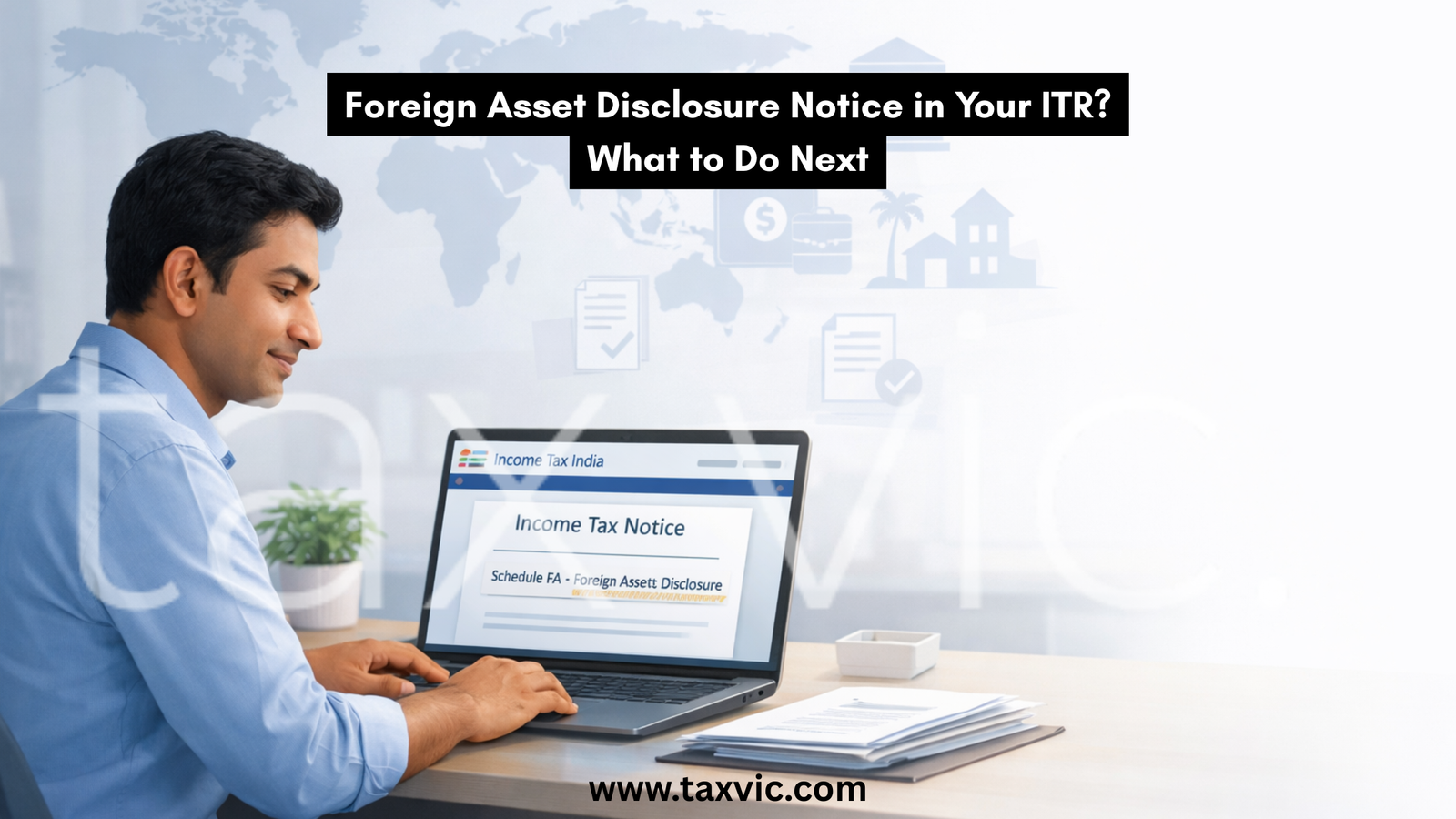
Many taxpayers are receiving income tax notices after filing their recent Income Tax Return (ITR), mentioning non-disclosure of foreign assets or foreign income.
If you’ve received such a notice, the first thing to remember is:
Don’t panic.
In most cases, this is a compliance issue, not a serious offence — and it can be handled properly if you respond correctly and on time.
Let’s understand this in simple language.
What Are “Foreign Assets” as per Income Tax Law?
Foreign assets include any financial account, investment, or asset located outside India, such as:
Foreign bank accounts
Overseas investment accounts
Foreign shares, ESOPs, or mutual funds
Property owned outside India
Any account opened or maintained abroad, even if used temporarily
Even if the money eventually comes to India, the foreign account or asset itself still needs to be disclosed.
Why Are These Notices Being Issued Now?
The Income Tax Department now receives international financial information under global data-sharing agreements.
Common reasons notices are issued:
Foreign bank or investment account not disclosed in Schedule FA
Foreign income earned but not properly reported
Assumption that “small amounts” or “inactive accounts” don’t need disclosure
Lack of awareness about disclosure rules
Errors or omissions while filing the return
In many cases, there is no intention to hide anything — it’s simply incomplete reporting.
Important Clarification (Very Important)
 Non-disclosure of a foreign asset does NOT automatically mean tax evasion.
The department mainly checks:
Was income earned?
Was tax paid on that income?
- Was full disclosure made?
If income has already been offered to tax, the issue is often procedural, not criminal.
What Type of Notices Are Usually Sent?
Most notices are issued under:
Section 139(9) – Defective return
Section 142(1) – Request for information
Automated compliance notices
These notices are not penalties by default. They are requests for clarification or correction.
What Should You Do Now? (Step-by-Step)
Step 1: Read the Notice Carefully
Check:
Assessment year mentioned
What exactly is missing (account, asset, income)
Time limit to respond
Never ignore the notice.
Step 2: Identify the Foreign Asset or Account
List out:
Type of asset or account
Country where it is located
Whether it was active during the year
Even dormant or low-value accounts matter for disclosure.
Step 3: Check Whether Income Was Already Declared
Ask yourself:
Was income from this source included in total income?
Was tax paid on it?
If yes, your explanation becomes much simpler.

Step 4: Respond Honestly and Clearly
Depending on the notice, you may need to:
File a revised return (if allowed)
Submit an online reply with explanation
Provide clarification stating the omission was unintentional
A clear and truthful explanation is always better than defensive language.
Step 5: Don’t Assume It’s a Black Money Case
The Black Money Act applies mainly when:
Assets are deliberately hidden
Income is not disclosed at all
There is clear intention to evade tax
For genuine taxpayers, most such notices do not escalate to that level.
How to Frame Your Reply (In Simple Words)
Your response should mention:
You are a resident taxpayer
Details of the foreign asset/account
That income (if any) has been disclosed and taxed
Non-disclosure was inadvertent
Willingness to fully comply and rectify
Polite, factual, and transparent replies usually resolve the matter smoothly.
How to Avoid Such Notices in Future
Going forward:
Always disclose foreign assets in Schedule FA
Inform your tax advisor about any overseas account or investment
Don’t assume that “small” or “temporary” accounts don’t matter
Review foreign disclosures carefully before filing
Final Word
Receiving a notice related to foreign assets can feel stressful, but in most cases, it is a compliance correction, not a punishment.
If you respond correctly and within time, these issues are usually resolved without heavy penalties.
When it comes to foreign assets, remember: Disclosure is as important as paying tax.